
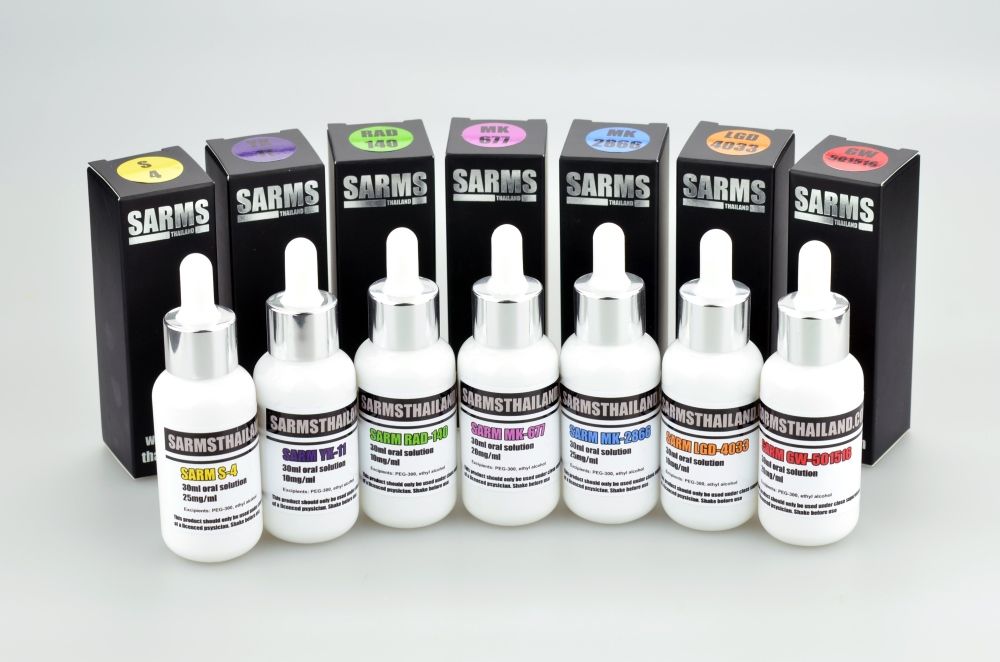
What Are SARMs? How They Work, Research & Risks
Updated August 2026
SARMs, or selective androgen receptor modulators, are investigational compounds designed to activate the androgen receptor in a more tissue-selective way than traditional anabolic-androgenic steroids.
That does not mean SARMs work only in muscle and bone, and it does not mean they are free from hormonal, cardiovascular, liver or other risks.
Some SARMs have been studied in controlled human trials for conditions involving muscle loss, physical function and other medical problems. Others have little or no meaningful human evidence. None should be assumed to have the same research profile simply because they are sold under the general term “SARMs.”
The U.S. FDA states that SARMs are not approved drugs for bodybuilding or athletic performance and has warned about potentially serious adverse effects associated with products marketed as SARMs.
View Liquid SARMs | View SARMs Compound Guides
What Does SARM Mean?
SARM stands for Selective Androgen Receptor Modulator.
The androgen receptor is a biological target activated by testosterone, dihydrotestosterone and other androgenic compounds. Traditional anabolic steroids also produce many of their effects through androgen-receptor signalling.
SARMs were developed in an attempt to produce useful anabolic effects in tissues such as muscle and bone while reducing activity in some other androgen-sensitive tissues.
The word selective is important, but it is often misunderstood.
It does not mean a SARM travels exclusively to muscle and ignores every other organ. Tissue selectivity is relative and depends on the compound, dose, receptor activity, tissue environment and other biological factors.
That is why the old idea that SARMs affect only muscle and bone while completely avoiding prostate, liver, cardiovascular or hormonal effects is not supported by the evidence.
How Do SARMs Work?
True SARMs bind to and activate the androgen receptor.
Once activated, the receptor influences gene transcription and biological processes in androgen-responsive tissues. Researchers have attempted to develop compounds that retain useful anabolic signalling while producing a different tissue-response profile from testosterone and traditional anabolic steroids.
This is the scientific basis behind the term selective androgen receptor modulator.
Different SARMs have different chemical structures, receptor activity, pharmacokinetics and levels of human research. Results from one SARM should therefore not automatically be applied to another.
Which Compounds Are Actually SARMs?
The performance market commonly groups a number of products together as “SARMs,” even though they do not all belong to the same pharmacological class.
| Compound | Compound Class | Technically a SARM? |
|---|---|---|
| Ostarine / MK-2866 / Enobosarm | Selective androgen receptor modulator | Yes |
| LGD-4033 / Ligandrol | Selective androgen receptor modulator | Yes |
| RAD-140 / Testolone | Selective androgen receptor modulator | Yes |
| S-4 / Andarine | Selective androgen receptor modulator | Yes |
| AC-262 / Accadrine | Selective androgen receptor modulator | Yes |
| MK-677 / Ibutamoren | Growth-hormone secretagogue / ghrelin-receptor agonist | No |
| Cardarine / GW-501516 | PPAR-delta agonist | No |
MK-677 and Cardarine are included in many SARM stores because customers commonly compare and combine them with SARMs. Their biological mechanisms are completely different, and they should not be described as selective androgen receptor modulators.
You can compare the current classifications, concentrations and product information in our Liquid SARMs in Thailand category.
What Does Human Research Actually Show?
The amount of human evidence varies considerably between compounds.
Ostarine / Enobosarm
Ostarine, also known as Enobosarm or GTx-024, is one of the better-studied SARMs.
A randomized controlled study in older men and postmenopausal women reported increases in lean body mass and changes in physical-function measurements during treatment with Enobosarm.
Other clinical-development programs have studied Enobosarm in people with cancer-related muscle loss and other medical conditions.
These results show biological activity in humans. They do not prove that recreational bodybuilding use produces predictable muscle gain, fat loss or performance improvements in healthy athletes.
See the full Ostarine MK-2866 research guide for a more detailed breakdown of the evidence.
LGD-4033 / Ligandrol
LGD-4033 has also been tested in controlled human research.
In a placebo-controlled study involving healthy young men, LGD-4033 produced a dose-related increase in lean body mass over the short study period.
The same study also reported dose-related suppression of total testosterone, changes in sex hormone-binding globulin and changes in HDL cholesterol.
That finding is particularly important because it directly contradicts the common marketing claim that SARMs cannot suppress natural testosterone.
Read the LGD-4033 Ligandrol guide for compound-specific research.
RAD-140 / Testolone
RAD-140 has substantially less human performance research than Ostarine or LGD-4033.
A first-in-human Phase 1 study evaluated RAD-140 in postmenopausal women with hormone-receptor-positive metastatic breast cancer. That study provides human pharmacology and safety information, but it was an oncology study rather than a bodybuilding or athletic-performance trial.
Animal, laboratory or cancer-patient findings should not be converted into guaranteed outcomes for healthy gym users.
See the RAD-140 Testolone guide for the current evidence review.
Do SARMs Build Muscle?
Several SARMs have produced measurable changes in lean body mass in controlled human studies.
However, lean body mass is not the same measurement as visible new muscle tissue. Lean mass measurements can also include changes in water, connective tissue and other non-fat components.
Results from controlled trials involving older adults, cancer patients or short-term experimental conditions also cannot automatically be translated into expected bodybuilding results.
Claims such as “gain X kilograms of muscle in eight weeks” should therefore be treated as marketing or anecdotal claims unless they are supported by an applicable controlled study.
Do SARMs Burn Fat?
SARMs are frequently marketed for cutting and body recomposition, but the research does not support treating every SARM as a direct fat-burning drug.
Some studies have measured body composition while investigating SARMs, but changes in fat mass differ between compounds and study populations.
Body-fat change remains heavily influenced by calorie intake, training, activity and other individual factors.
Cardarine is also frequently discussed in cutting contexts, but Cardarine is not a SARM. It works through PPAR-delta rather than the androgen receptor.
Are SARMs Safer Than Steroids?
This question needs more nuance than the old claim that SARMs provide steroid-like results with no steroid-like side effects.
SARMs were developed partly because researchers wanted more tissue-selective anabolic compounds. That scientific goal does not prove that recreational SARM use is safe.
The U.S. FDA warns that products marketed as SARMs have been associated with serious or potentially life-threatening problems, including liver injury and cardiovascular, reproductive and psychiatric effects.
Read the FDA warning on selective androgen receptor modulators.
There is also no scientific basis for saying that SARMs universally produce “no unwanted side effects.”
Can SARMs Suppress Testosterone?
Yes, hormonal suppression can occur with androgen-receptor-active SARMs.
The controlled LGD-4033 trial in healthy men reported dose-dependent suppression of total testosterone and other hormonal measurements.
The magnitude and recovery pattern can vary according to the compound, exposure and individual response, so one universal claim about suppression does not apply to every SARM or every person.
This is why post-cycle decisions should not be based simply on statements such as “all SARMs need PCT” or “SARMs never need PCT.”
Do SARMs Damage the Liver?
It is inaccurate to describe SARMs as automatically non-toxic to the liver.
Liver injury has been reported in association with products containing or marketed as SARMs, and the FDA includes liver injury and acute liver failure among the significant risks it warns consumers about.
The risk profile can differ between compounds, products and patterns of use.
Product quality is another variable because an online product labeled as one SARM may not necessarily contain exactly what the label claims.
Product Quality and Mislabeling
One of the biggest problems in the SARM market is that the name on a bottle does not automatically prove what is inside it.
A published JAMA investigation chemically analyzed 44 products sold online as SARMs. Only 23 of the 44 products contained one or more actual SARMs, while other products contained different unapproved drugs, undeclared substances or no active compound.
Only 18 of the 44 tested products contained an amount of active compound that matched the product label.
Read the published product-composition study.
This is why product identity, concentration and available batch documentation matter when comparing suppliers.
SARMs vs Anabolic Steroids
SARMs and anabolic steroids overlap because both can produce biological effects through androgen-receptor signalling, but they are not the same type of compound.
| SARMs | Anabolic Steroids | |
|---|---|---|
| Primary target | Androgen receptor | Androgen receptor |
| Development goal | More tissue-selective androgen signalling | Broad anabolic and androgenic activity varies by steroid |
| Common formats | Many investigational SARMs are orally active | Oral and injectable compounds |
| Hormonal suppression | Can occur | Can occur |
| Clinical evidence | Varies greatly by compound | Varies by compound and approved medical use |
| Bodybuilding approval | No approved SARM bodybuilding indication | Non-medical bodybuilding use is separate from approved medical uses |
SARMS Thailand is focused on SARMs and related compounds. If you are researching traditional anabolic steroids rather than SARMs, compare those separately rather than treating the two categories as interchangeable.
SARMs and PCT
Post-cycle considerations depend on the specific androgen-receptor compound, amount used, duration, previous exposure and individual hormonal response.
Not every SARM produces identical suppression, and there is no evidence-based rule that one fixed PCT protocol is appropriate after every SARM cycle.
Blood testing before and after exposure provides more useful information than guessing from symptoms alone.
The SARM PCT & Post-Cycle Support section compares products commonly discussed specifically in the context of post-cycle support after SARMs.
SARM Stacks
A SARM stack combines more than one compound within the same cycle or package.
Using several compounds does not turn them into one new substance. Each ingredient still has its own biological mechanism, research profile and potential risks.
Some commercial SARM stacks also contain products such as MK-677 or Cardarine, which are not technically SARMs.
Current combinations and their individual ingredients can be reviewed in the SARM Stacks in Thailand category.
Are SARMs Banned in Sport?
Yes. The World Anti-Doping Agency prohibits selective androgen receptor modulators under its anabolic-agents category.
The 2026 WADA Prohibited List specifically includes SARMs such as Andarine, Enobosarm/Ostarine, LGD-4033, RAD-140 and other androgen receptor modulators.
Athletes subject to WADA or WADA-aligned anti-doping rules should therefore avoid SARMs.
View the 2026 WADA Prohibited List.
Buying SARMs in Thailand
SARMS Thailand lists the current product name, concentration, bottle size, price and stock status on the individual product pages.
True SARMs currently listed alongside related performance compounds can be compared in the Liquid SARMs in Thailand category.
Do not assume that every compound sold in the same category has the same mechanism or evidence base. Check the individual product and compound guide before comparing two products.
For deeper research on Ostarine, LGD-4033, RAD-140, S-4, YK-11, MK-677 and Cardarine, see the complete SARMs Compound Guides.
Frequently Asked Questions
What does SARM stand for?
SARM stands for Selective Androgen Receptor Modulator.
Are SARMs steroids?
No. SARMs and anabolic steroids are different compound classes, although both can produce effects through androgen-receptor signalling.
Is Ostarine a SARM?
Yes. Ostarine, also known as MK-2866 or Enobosarm, is a selective androgen receptor modulator.
Is LGD-4033 a SARM?
Yes. LGD-4033, commonly called Ligandrol, is a selective androgen receptor modulator.
Is RAD-140 a SARM?
Yes. RAD-140, also known as Testolone, is a selective androgen receptor modulator.
Is MK-677 a SARM?
No. MK-677, or Ibutamoren, is a growth-hormone secretagogue and ghrelin-receptor agonist. It is commonly sold alongside SARMs but works through a different biological pathway.
Is Cardarine a SARM?
No. Cardarine GW-501516 is a PPAR-delta agonist. It does not work through the androgen receptor.
Do SARMs shut down testosterone?
Some androgen-receptor-active SARMs can suppress testosterone and other hormonal measurements. The effect varies by compound and exposure. Controlled LGD-4033 research has documented testosterone suppression in healthy men.
Are SARMs free from liver toxicity?
No. It is not accurate to describe SARMs as universally non-toxic to the liver. Liver injury has been reported in association with products marketed as SARMs.
Are SARMs approved for bodybuilding?
No SARM is FDA-approved specifically for bodybuilding or athletic performance. Several compounds remain investigational and have been studied for other medical research purposes.
Are SARMs banned for tested athletes?
Yes. SARMs are prohibited under the World Anti-Doping Agency Prohibited List.
SARMs Research Sources
- U.S. FDA — Warning on Selective Androgen Receptor Modulators
- Basaria et al. — Controlled LGD-4033 study in healthy men
- Dalton et al. — Controlled Enobosarm/Ostarine study
- LoRusso et al. — First-in-human Phase 1 RAD-140 study
- Van Wagoner et al. — Chemical composition and labeling of products marketed as SARMs
- World Anti-Doping Agency — 2026 Prohibited List
Article Information
Prepared by the SARMS Thailand Editorial Team.
This guide uses controlled human research, peer-reviewed publications and authoritative public sources. Human research, preclinical findings and commercial-market claims are treated separately.
Commercial disclosure: SARMS Thailand sells SARMs and related performance compounds discussed on this page. Product availability does not change the strength or limitations of the underlying scientific evidence.
Read our Editorial Policy for information about sourcing, evidence standards, commercial disclosures and corrections.
This page provides general educational information and is not individualized medical advice.